Shop for retail display boxes and you quickly hit a wall of acronyms: CDU, PDQ, FSDU, dump bin, shipper. They are not interchangeable. Each one is built for a specific place in the store and a specific kind of product, and ordering the wrong format means a display that either drowns your product or collapses under it. This is a plain guide to what each type is, where it belongs, and how to spec the board underneath it.
Counter and shelf displays: CDU and PDQ
The smallest formats live where customers pause. A counter display unit, or CDU, sits on the checkout counter or another high-traffic surface and is built to trigger impulse buys during payment. It suits small, lower-priced items, the lip balms, candies, and small gadgets that a shopper adds without much thought, typically things under about twenty dollars. A PDQ tray, short for “pretty darn quick,” is a shelf-ready format designed to be opened and placed straight onto a shelf without unpacking each unit. Its whole reason for existing is speed: staff cut one tab, slide the tray onto the shelf, and the product is merchandised, which cuts restocking labor dramatically compared with stacking loose units. Both are corrugated and both target small impulse products; the difference is placement, with the CDU claiming counter space and the PDQ living on the shelf.
Floor displays: the FSDU and its sizes
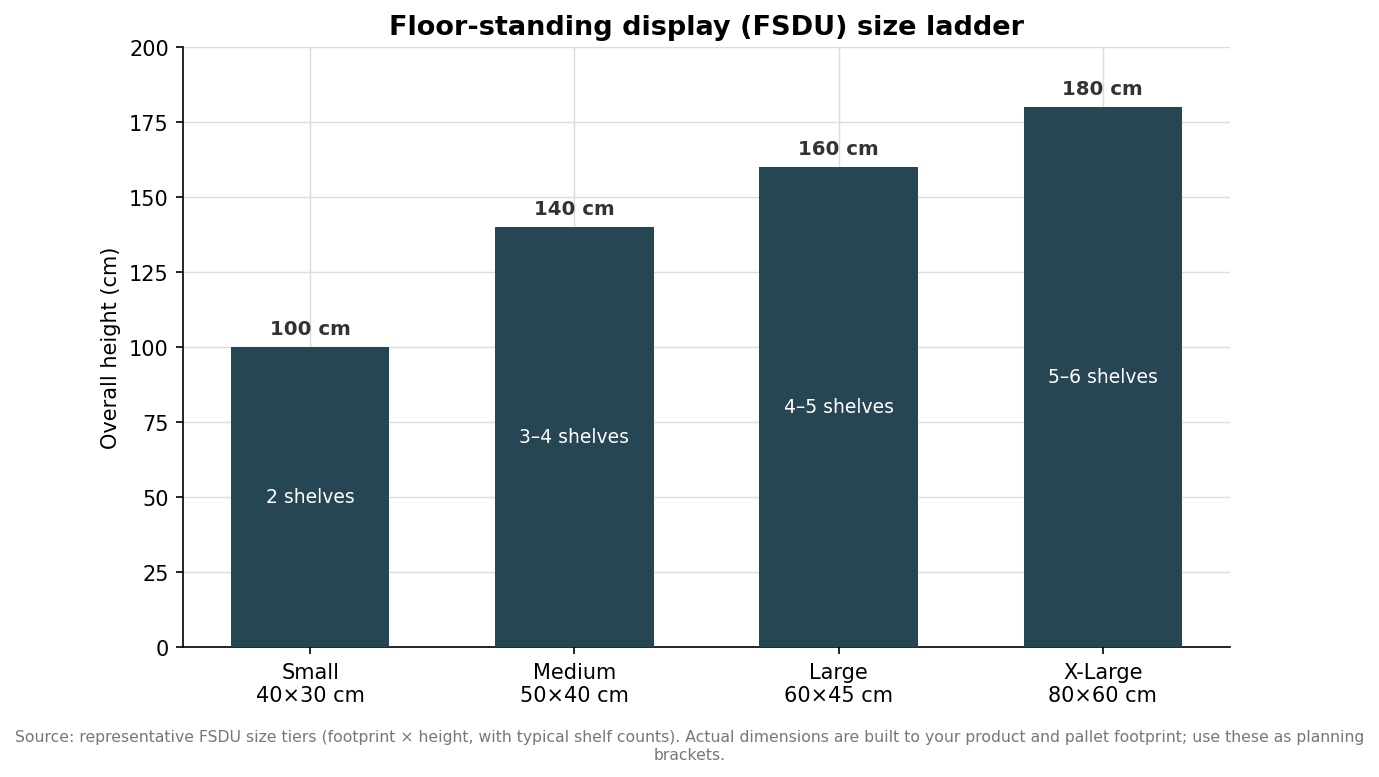
When you want a standalone presence on the shop floor, you want a free-standing display unit, or FSDU. This is the tall, multi-shelf cardboard tower that holds a product range at eye level in an aisle end or open floor space. FSDUs scale in fairly predictable tiers. A small unit runs around 40 by 30 cm in footprint and about 100 cm tall with two shelves, a medium around 50 by 40 cm and 140 cm tall with three or four shelves, a large near 60 by 45 cm and 160 cm with four or five shelves, and an extra-large around 80 by 60 cm and 180 cm with five or six shelves. In practice the exact dimensions are built around your product and, for shipped displays, the pallet footprint, so treat these tiers as planning brackets rather than a fixed catalog.
Bulk and shipper displays: dump bins and shelf-ready
Two more formats round out the range. A dump bin is exactly what it sounds like: a floor bin that holds loose product in bulk for a grab-and-go, discovery-driven purchase, which is why you see them full of discounted or seasonal items. Because the load is loose and heavy, dump bins lean on stronger board and a reinforced base. Shipper displays, sometimes called shelf-ready or retail-ready packaging, do double duty: the product ships inside the display, and the same unit converts into the merchandising fixture on arrival, saving a separate packing and unpacking step. Choosing among these comes down to how the product is bought. Considered purchases want the tidy shelves of an FSDU; impulse and clearance want the openness of a dump bin; efficiency-focused retailers want the ship-and-display convenience of a shipper.
Matching board and flute to product weight
The format sets the shape, but the flute sets whether it survives. Corrugated board is chosen by the weight it has to carry. As a working guide, light products under about 3 kg sit happily on E-flute, medium loads of roughly 3 to 8 kg call for B-flute, and heavier products from 8 kg upward need C-flute or double-wall board. Translated to shelves, a standard B-flute display typically supports something like 15 to 30 kg per shelf, while a double-wall build pushes that to roughly 30 to 60 kg per shelf. For premium branded displays where the print has to look sharp, a litho-laminate finish bonds a high-quality printed sheet to the corrugated board, giving you photographic graphics on a structural base. Tell your supplier the actual product weight and how many facings per shelf, and let that drive the board rather than guessing, because an under-specced flute is how a full display sags by week two.
What each type costs you in minimums and lead time
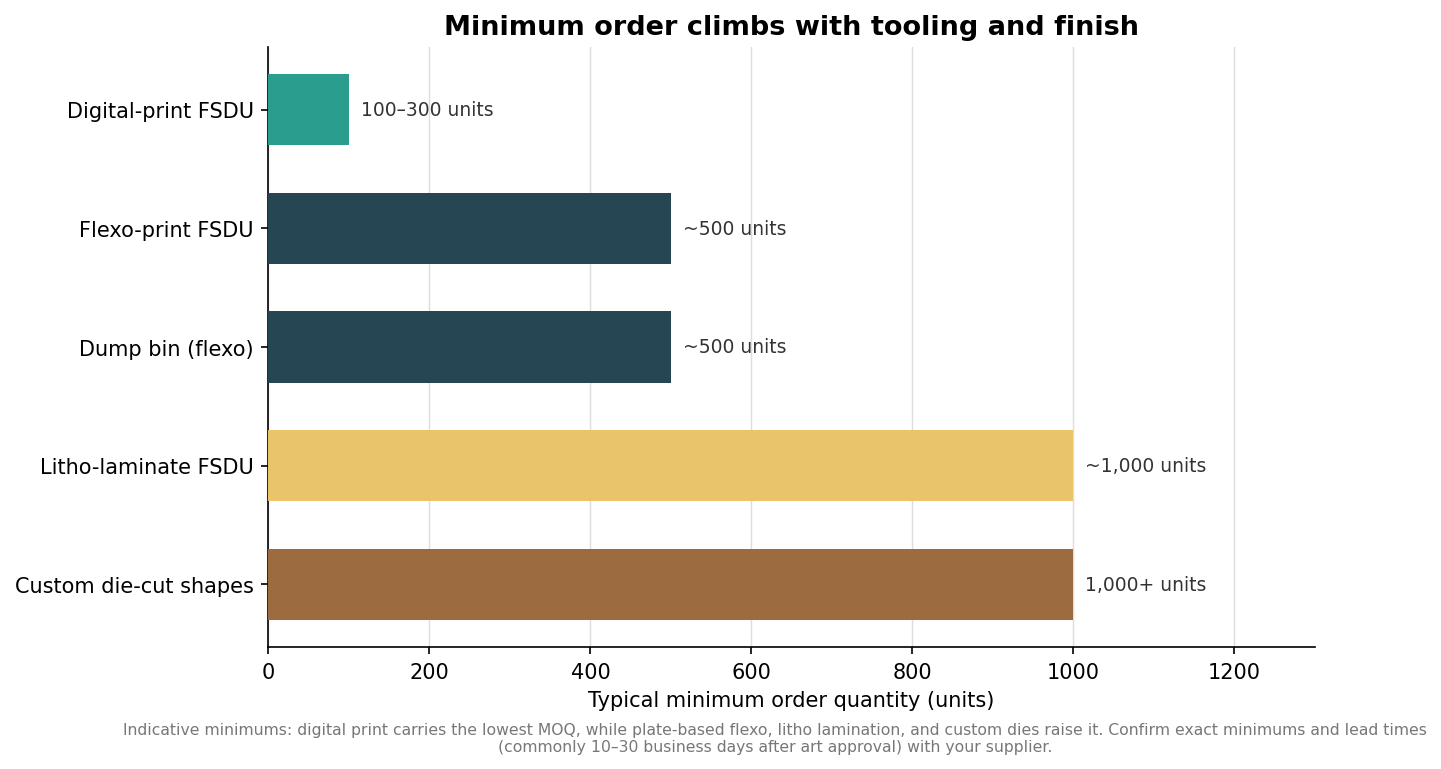
The format and finish you choose also set your economics. Digital-printed displays carry the lowest minimums, often in the low hundreds of units, because there are no plates to pay off. Plate-based flexo FSDUs and dump bins commonly start around 500 units, litho-laminate displays around 1,000, and fully custom die-cut shapes at 1,000 or more, since the die and setup only make sense at volume. Lead times run in a similar band: digital work often turns in about 10 to 15 business days after artwork approval, standard production in roughly 15 to 25, and large litho runs in 20 to 30, with samples usually available inside 5 to 10 days. These are indicative and vary by supplier and season, so confirm them before you commit to an in-store date. Get the format matched to the shopping behavior, the board matched to the weight, and the print method matched to your volume, and the display does its one job: keeping product upright, on-brand, and in front of the right shopper.
Leave a Reply