Category: Uncategorized

  • Retail Display Types Explained: CDU, PDQ, FSDU, and Dump Bins

    Retail Display Types Explained: CDU, PDQ, FSDU, and Dump Bins

    Shop for retail display boxes and you quickly hit a wall of acronyms: CDU, PDQ, FSDU, dump bin, shipper. They are not interchangeable. Each one is built for a specific place in the store and a specific kind of product, and ordering the wrong format means a display that either drowns your product or collapses under it. This is a plain guide to what each type is, where it belongs, and how to spec the board underneath it.

    Counter and shelf displays: CDU and PDQ

    The smallest formats live where customers pause. A counter display unit, or CDU, sits on the checkout counter or another high-traffic surface and is built to trigger impulse buys during payment. It suits small, lower-priced items, the lip balms, candies, and small gadgets that a shopper adds without much thought, typically things under about twenty dollars. A PDQ tray, short for “pretty darn quick,” is a shelf-ready format designed to be opened and placed straight onto a shelf without unpacking each unit. Its whole reason for existing is speed: staff cut one tab, slide the tray onto the shelf, and the product is merchandised, which cuts restocking labor dramatically compared with stacking loose units. Both are corrugated and both target small impulse products; the difference is placement, with the CDU claiming counter space and the PDQ living on the shelf.

    Floor displays: the FSDU and its sizes

    When you want a standalone presence on the shop floor, you want a free-standing display unit, or FSDU. This is the tall, multi-shelf cardboard tower that holds a product range at eye level in an aisle end or open floor space. FSDUs scale in fairly predictable tiers. A small unit runs around 40 by 30 cm in footprint and about 100 cm tall with two shelves, a medium around 50 by 40 cm and 140 cm tall with three or four shelves, a large near 60 by 45 cm and 160 cm with four or five shelves, and an extra-large around 80 by 60 cm and 180 cm with five or six shelves. In practice the exact dimensions are built around your product and, for shipped displays, the pallet footprint, so treat these tiers as planning brackets rather than a fixed catalog.
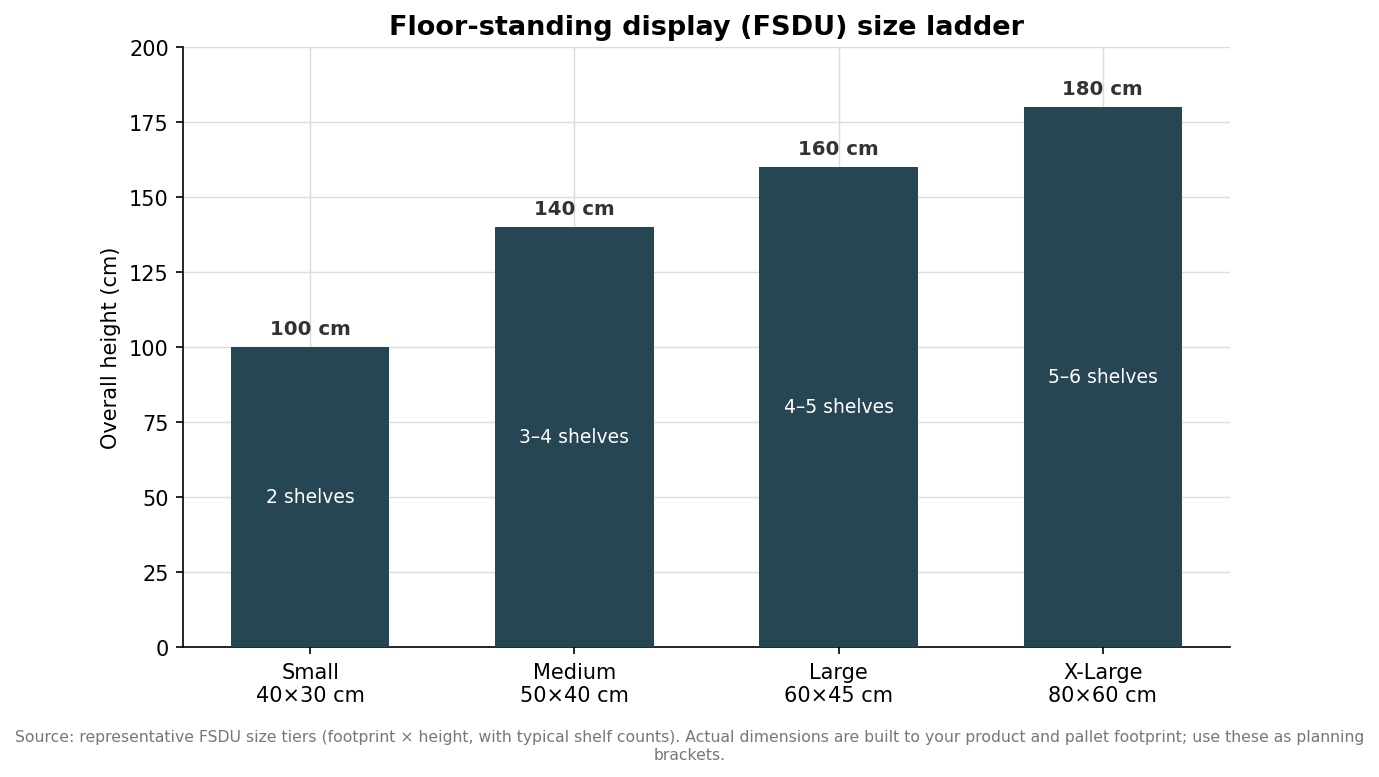
    Bar chart of floor-standing display unit size tiers by height in centimeters with typical shelf counts
    FSDU sizes scale in predictable tiers; final dimensions are built around your product and pallet footprint.

    Bulk and shipper displays: dump bins and shelf-ready

    Two more formats round out the range. A dump bin is exactly what it sounds like: a floor bin that holds loose product in bulk for a grab-and-go, discovery-driven purchase, which is why you see them full of discounted or seasonal items. Because the load is loose and heavy, dump bins lean on stronger board and a reinforced base. Shipper displays, sometimes called shelf-ready or retail-ready packaging, do double duty: the product ships inside the display, and the same unit converts into the merchandising fixture on arrival, saving a separate packing and unpacking step. Choosing among these comes down to how the product is bought. Considered purchases want the tidy shelves of an FSDU; impulse and clearance want the openness of a dump bin; efficiency-focused retailers want the ship-and-display convenience of a shipper.

    Matching board and flute to product weight

    The format sets the shape, but the flute sets whether it survives. Corrugated board is chosen by the weight it has to carry. As a working guide, light products under about 3 kg sit happily on E-flute, medium loads of roughly 3 to 8 kg call for B-flute, and heavier products from 8 kg upward need C-flute or double-wall board. Translated to shelves, a standard B-flute display typically supports something like 15 to 30 kg per shelf, while a double-wall build pushes that to roughly 30 to 60 kg per shelf. For premium branded displays where the print has to look sharp, a litho-laminate finish bonds a high-quality printed sheet to the corrugated board, giving you photographic graphics on a structural base. Tell your supplier the actual product weight and how many facings per shelf, and let that drive the board rather than guessing, because an under-specced flute is how a full display sags by week two.
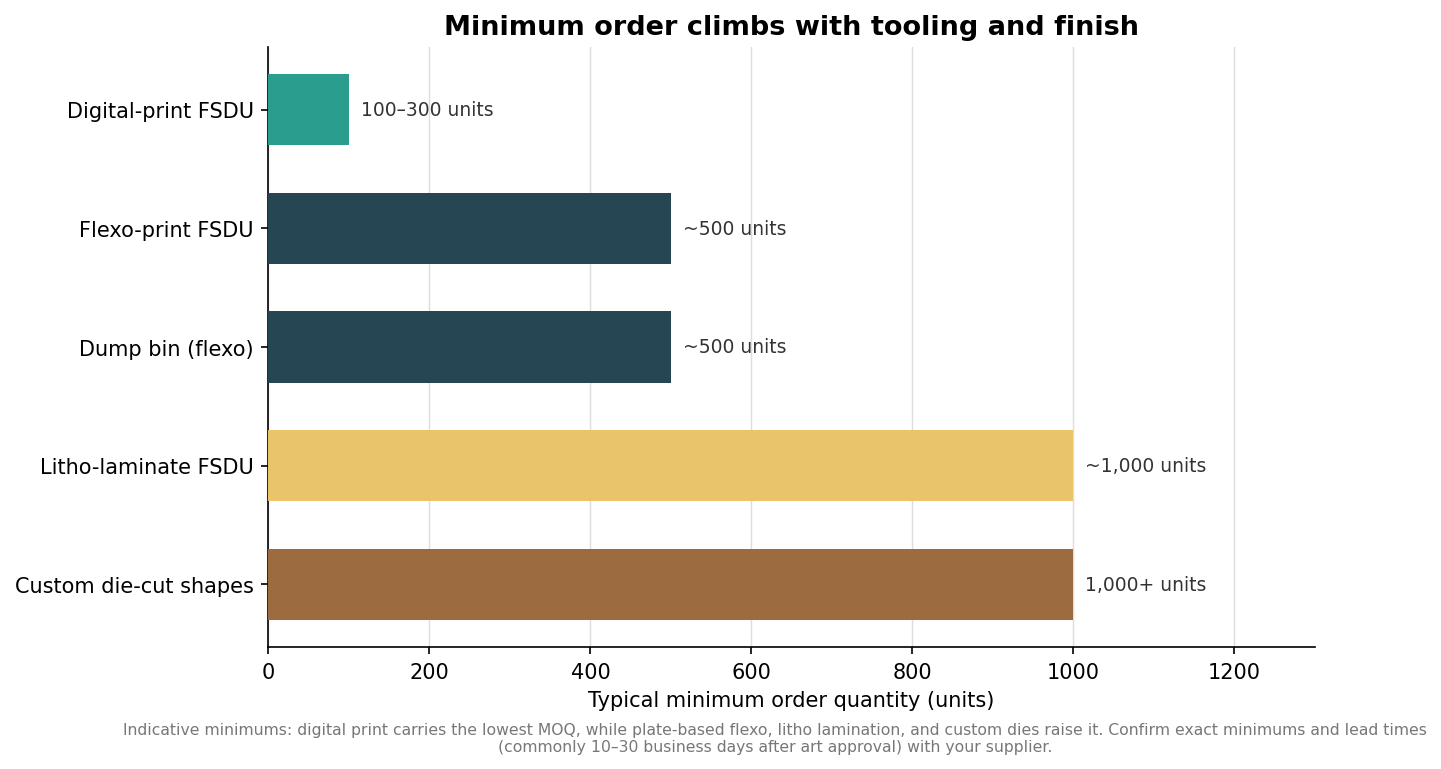
    Horizontal bar chart of typical minimum order quantities by display and print type, from digital to custom die-cut
    Minimum order quantity rises with tooling and finish: digital print is lowest, custom dies and litho lamination the highest.

    What each type costs you in minimums and lead time

    The format and finish you choose also set your economics. Digital-printed displays carry the lowest minimums, often in the low hundreds of units, because there are no plates to pay off. Plate-based flexo FSDUs and dump bins commonly start around 500 units, litho-laminate displays around 1,000, and fully custom die-cut shapes at 1,000 or more, since the die and setup only make sense at volume. Lead times run in a similar band: digital work often turns in about 10 to 15 business days after artwork approval, standard production in roughly 15 to 25, and large litho runs in 20 to 30, with samples usually available inside 5 to 10 days. These are indicative and vary by supplier and season, so confirm them before you commit to an in-store date. Get the format matched to the shopping behavior, the board matched to the weight, and the print method matched to your volume, and the display does its one job: keeping product upright, on-brand, and in front of the right shopper.
  • Corrugated Flutes and Board Grades for Display Boxes, Compared

    Corrugated Flutes and Board Grades for Display Boxes, Compared

    Two specifications decide almost everything about a custom display box: the flute profile of the corrugated board and the board grade behind it. The flute profile controls how thick the wall is and how cleanly your graphics print. The grade, expressed as an edge crush or burst rating, controls how much weight the display holds before it buckles. A counter unit that carries lip balm and a floor display that holds a case of canned drinks are the same product category built from very different board, and picking the wrong one shows up either as a fuzzy print or as a display that sags on the shelf. Here is how the common options compare and where each belongs.

    Flute profile sets print quality and thickness

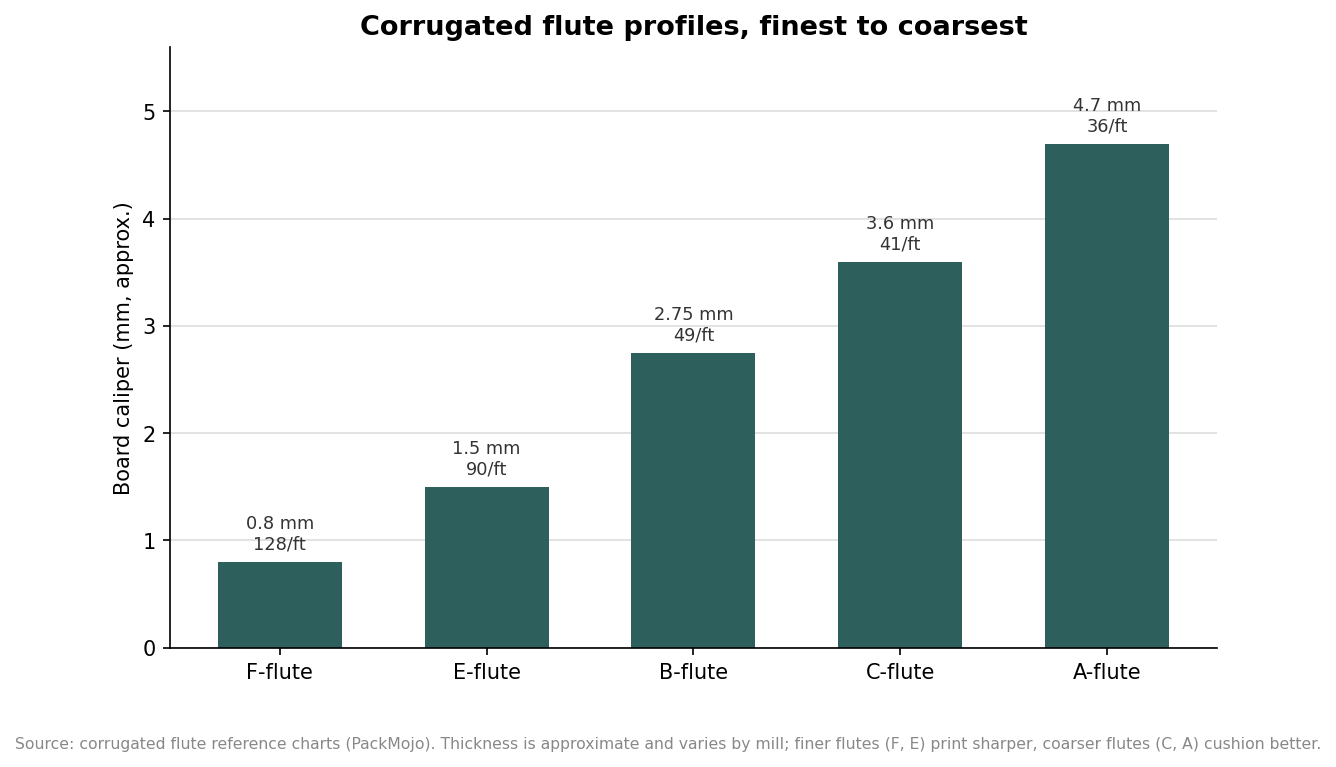
    Corrugated board is a fluted medium glued between liners, and the size of that flute is named by letter. Counterintuitively, the letters are not in size order: A-flute is the tallest at roughly 4.7 mm with about 36 flutes per foot, C-flute sits near 3.6 mm, B-flute around 2.5 to 3 mm, E-flute near 1.5 mm, and F-flute is the finest common profile at about 0.8 mm with roughly 128 flutes per foot. The taller the flute, the more air it traps and the more cushioning and vertical strength it offers. The finer the flute, the flatter and smoother the surface, which is what you want when a display has to carry sharp retail graphics.

    For display work the fine flutes usually win on looks. E-flute and F-flute print high-quality graphics because their dense, shallow structure resists the rippled “washboarding” that coarse flutes telegraph through the liner. B-flute is the middle ground favored for point-of-purchase displays and canned-goods trays that need more crush resistance than E can give while still printing acceptably. A-flute and C-flute earn their keep in shipping and heavier structures rather than on the graphic face. The chart below lines the profiles up by thickness.

    Bar chart comparing corrugated flute profiles F, E, B, C and A by board thickness in millimeters
    Flute letters are not in size order: F is the finest at about 0.8 mm, A the tallest near 4.7 mm.

    When a display needs a second wall

    Single-wall board, one fluted layer between two liners, handles the majority of counter displays and small floor units. You move to double-wall, two fluted layers, when the display is tall, holds dense product, or has to survive being stacked in a truck on the way to the store. A common trick is to combine profiles: a double-wall board pairing a coarse flute for strength with a fine flute for print, such as a BC or an EB construction, gives you a display that both carries weight and takes graphics on its show face.

    Height and load drive the decision more than product value. A jewelry counter display weighs almost nothing and stays single-wall E or F for the finish. A floor display holding several cases of product needs the stacking strength that only a double-wall grade delivers, because the failure you are guarding against is the display slowly crushing under its own filled weight over the days it sits on the sales floor.

    ECT and Mullen: reading the strength stamp

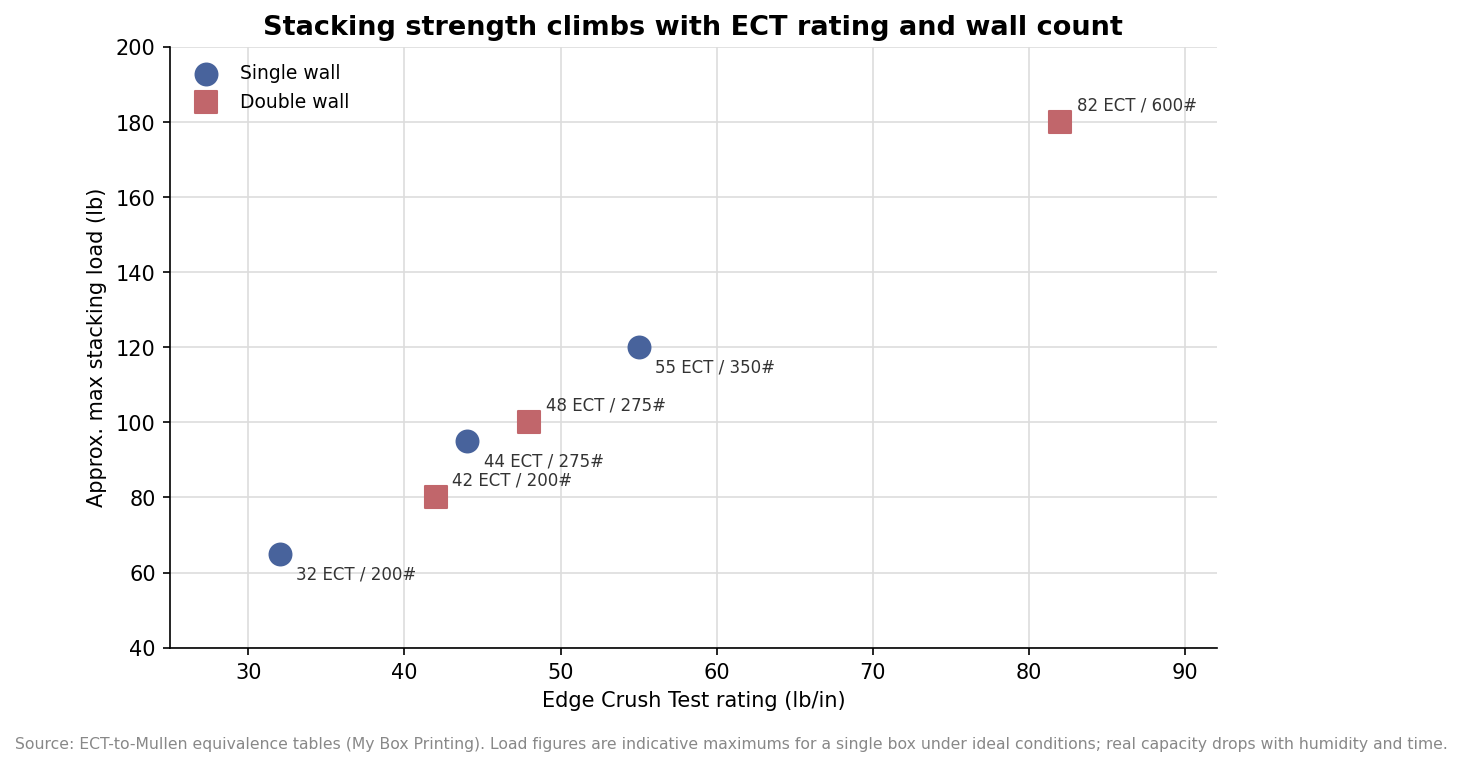
    Board strength is certified two ways, and they measure different things. The Edge Crush Test (ECT) measures vertical stacking strength in pounds per linear inch, which is the number that matters most for a display expected to hold product and possibly bear a unit stacked on top of it in transit. The Mullen burst test measures puncture and bursting resistance in pounds per square inch, which matters more for boxes taking rough handling and long-distance freight. The two are loosely cross-referenced: a 32 ECT single-wall board is roughly equivalent to 200-pound Mullen and supports on the order of 65 pounds, while a 44 ECT board maps to about 275-pound Mullen and near 95 pounds. Double-wall grades climb from there, with an 82 ECT board reaching around 600-pound Mullen.

    For displays, read the ECT number first. Because a display fails by crushing under sustained vertical load rather than by being punctured, the edge crush rating is the more honest predictor of whether your unit will still stand straight at the end of a promotion. Treat published load figures as ideal-condition maximums, though: humidity pulls strength out of corrugated, and a board sitting loaded for two weeks carries less than the same board tested dry and fresh. The relationship between ECT rating and stacking load is shown below.

    Scatter plot of Edge Crush Test rating versus maximum stacking load for single-wall and double-wall corrugated grades
    Stacking strength rises with the ECT rating and with adding a second wall of board.

    Matching board to the display format

    The format tells you most of what you need. A countertop display or a PDQ tray that holds light impulse product is comfortable in single-wall E-flute, often litho-laminated for a premium printed face. A shelf-ready tray for canned or bottled goods leans on B-flute for the extra crush resistance those products demand. A full floor display, dump bin, or half-pallet unit that holds real weight belongs in a double-wall grade, frequently a BC or EB combination so the structure carries the load while the outer liner still prints cleanly. When in doubt, spec up one grade rather than down; the cost difference per unit is small next to the cost of a display that collapses mid-campaign.

    Getting the print onto corrugated

    How the graphics reach the board is its own choice. Litho-lamination prints a sheet offset, then bonds it to the corrugated, and it produces the sharpest, most photographic result, which is why it dominates premium retail displays on fine flutes. Direct flexographic printing lays ink straight onto the board and is economical for bold, simple artwork but struggles with fine detail and gradients. Digital printing sits between them and is increasingly used for short runs and versioned displays where plate costs would otherwise dominate. Whatever the method, the coarser the flute, the more the fluting can show through as faint ridges under a large solid, so heavy ink coverage and photographic images are one more reason to favor E and F flutes on the printed face. Decide the flute, the wall count, the ECT grade, and the print method together, because on a display box those four specifications are not independent, and choosing them as a set is what separates a unit that sells product from one that becomes a returns problem.

  • Hello world!

    Welcome to WordPress. This is your first post. Edit or delete it, then start writing!