Two specifications decide almost everything about a custom display box: the flute profile of the corrugated board and the board grade behind it. The flute profile controls how thick the wall is and how cleanly your graphics print. The grade, expressed as an edge crush or burst rating, controls how much weight the display holds before it buckles. A counter unit that carries lip balm and a floor display that holds a case of canned drinks are the same product category built from very different board, and picking the wrong one shows up either as a fuzzy print or as a display that sags on the shelf. Here is how the common options compare and where each belongs.
Flute profile sets print quality and thickness
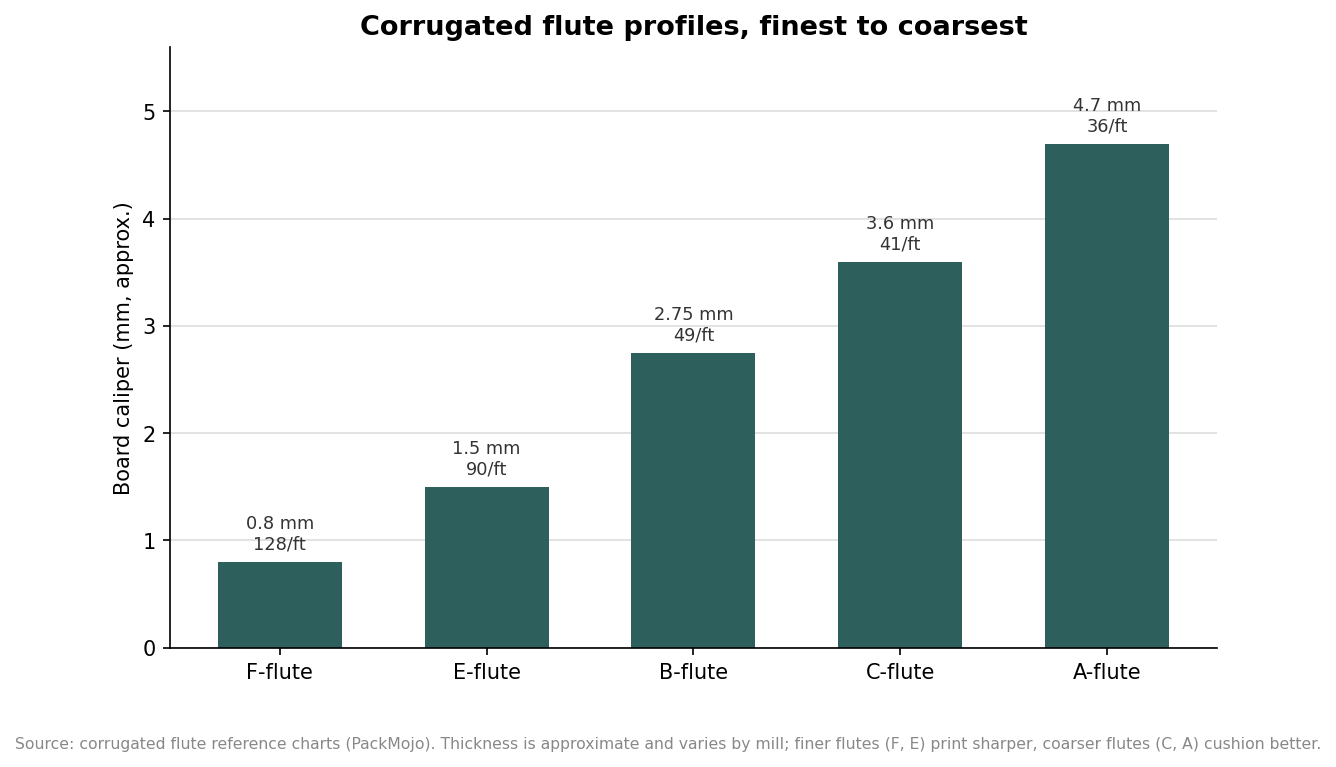
Corrugated board is a fluted medium glued between liners, and the size of that flute is named by letter. Counterintuitively, the letters are not in size order: A-flute is the tallest at roughly 4.7 mm with about 36 flutes per foot, C-flute sits near 3.6 mm, B-flute around 2.5 to 3 mm, E-flute near 1.5 mm, and F-flute is the finest common profile at about 0.8 mm with roughly 128 flutes per foot. The taller the flute, the more air it traps and the more cushioning and vertical strength it offers. The finer the flute, the flatter and smoother the surface, which is what you want when a display has to carry sharp retail graphics.
For display work the fine flutes usually win on looks. E-flute and F-flute print high-quality graphics because their dense, shallow structure resists the rippled “washboarding” that coarse flutes telegraph through the liner. B-flute is the middle ground favored for point-of-purchase displays and canned-goods trays that need more crush resistance than E can give while still printing acceptably. A-flute and C-flute earn their keep in shipping and heavier structures rather than on the graphic face. The chart below lines the profiles up by thickness.
When a display needs a second wall
Single-wall board, one fluted layer between two liners, handles the majority of counter displays and small floor units. You move to double-wall, two fluted layers, when the display is tall, holds dense product, or has to survive being stacked in a truck on the way to the store. A common trick is to combine profiles: a double-wall board pairing a coarse flute for strength with a fine flute for print, such as a BC or an EB construction, gives you a display that both carries weight and takes graphics on its show face.
Height and load drive the decision more than product value. A jewelry counter display weighs almost nothing and stays single-wall E or F for the finish. A floor display holding several cases of product needs the stacking strength that only a double-wall grade delivers, because the failure you are guarding against is the display slowly crushing under its own filled weight over the days it sits on the sales floor.
ECT and Mullen: reading the strength stamp
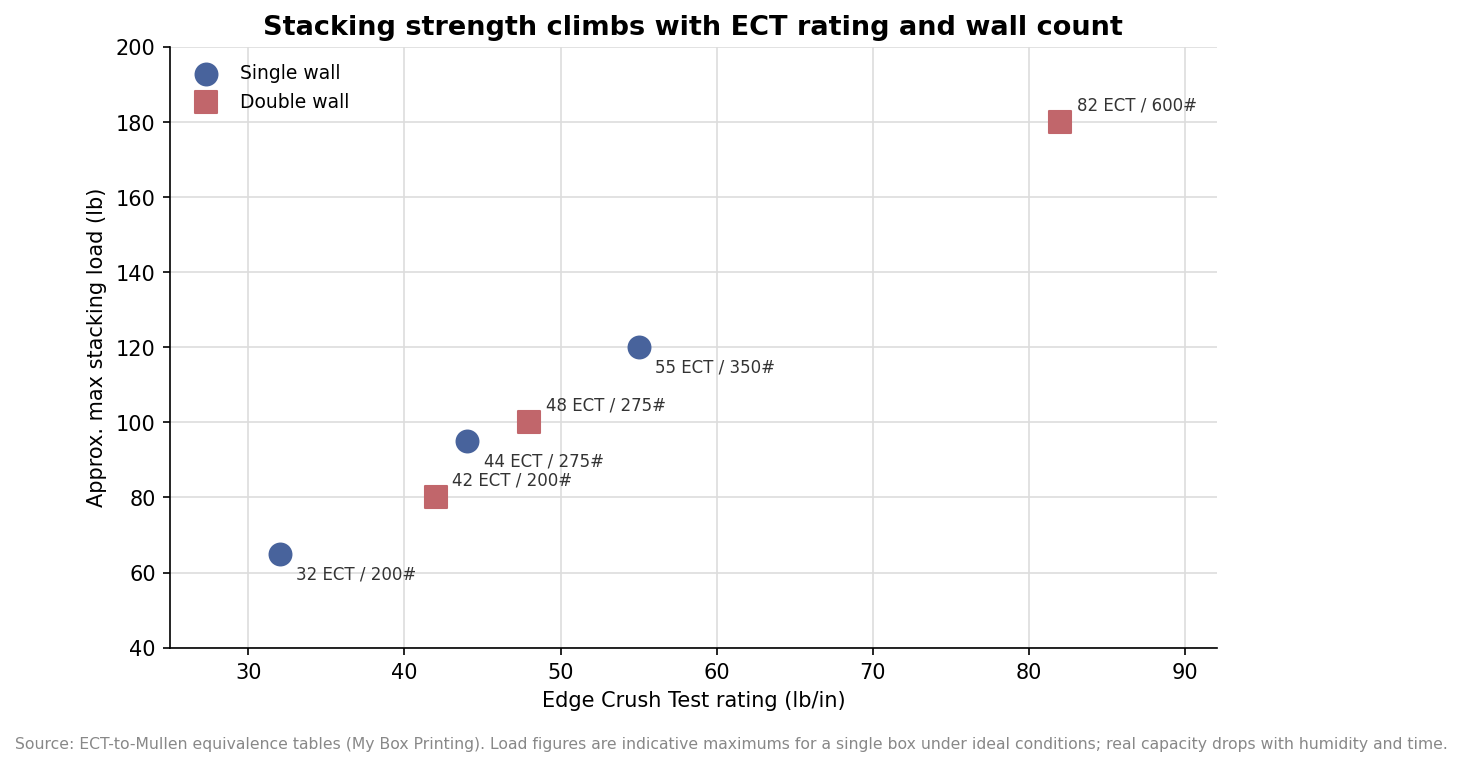
Board strength is certified two ways, and they measure different things. The Edge Crush Test (ECT) measures vertical stacking strength in pounds per linear inch, which is the number that matters most for a display expected to hold product and possibly bear a unit stacked on top of it in transit. The Mullen burst test measures puncture and bursting resistance in pounds per square inch, which matters more for boxes taking rough handling and long-distance freight. The two are loosely cross-referenced: a 32 ECT single-wall board is roughly equivalent to 200-pound Mullen and supports on the order of 65 pounds, while a 44 ECT board maps to about 275-pound Mullen and near 95 pounds. Double-wall grades climb from there, with an 82 ECT board reaching around 600-pound Mullen.
For displays, read the ECT number first. Because a display fails by crushing under sustained vertical load rather than by being punctured, the edge crush rating is the more honest predictor of whether your unit will still stand straight at the end of a promotion. Treat published load figures as ideal-condition maximums, though: humidity pulls strength out of corrugated, and a board sitting loaded for two weeks carries less than the same board tested dry and fresh. The relationship between ECT rating and stacking load is shown below.
Matching board to the display format
The format tells you most of what you need. A countertop display or a PDQ tray that holds light impulse product is comfortable in single-wall E-flute, often litho-laminated for a premium printed face. A shelf-ready tray for canned or bottled goods leans on B-flute for the extra crush resistance those products demand. A full floor display, dump bin, or half-pallet unit that holds real weight belongs in a double-wall grade, frequently a BC or EB combination so the structure carries the load while the outer liner still prints cleanly. When in doubt, spec up one grade rather than down; the cost difference per unit is small next to the cost of a display that collapses mid-campaign.
Getting the print onto corrugated
How the graphics reach the board is its own choice. Litho-lamination prints a sheet offset, then bonds it to the corrugated, and it produces the sharpest, most photographic result, which is why it dominates premium retail displays on fine flutes. Direct flexographic printing lays ink straight onto the board and is economical for bold, simple artwork but struggles with fine detail and gradients. Digital printing sits between them and is increasingly used for short runs and versioned displays where plate costs would otherwise dominate. Whatever the method, the coarser the flute, the more the fluting can show through as faint ridges under a large solid, so heavy ink coverage and photographic images are one more reason to favor E and F flutes on the printed face. Decide the flute, the wall count, the ECT grade, and the print method together, because on a display box those four specifications are not independent, and choosing them as a set is what separates a unit that sells product from one that becomes a returns problem.
Leave a Reply